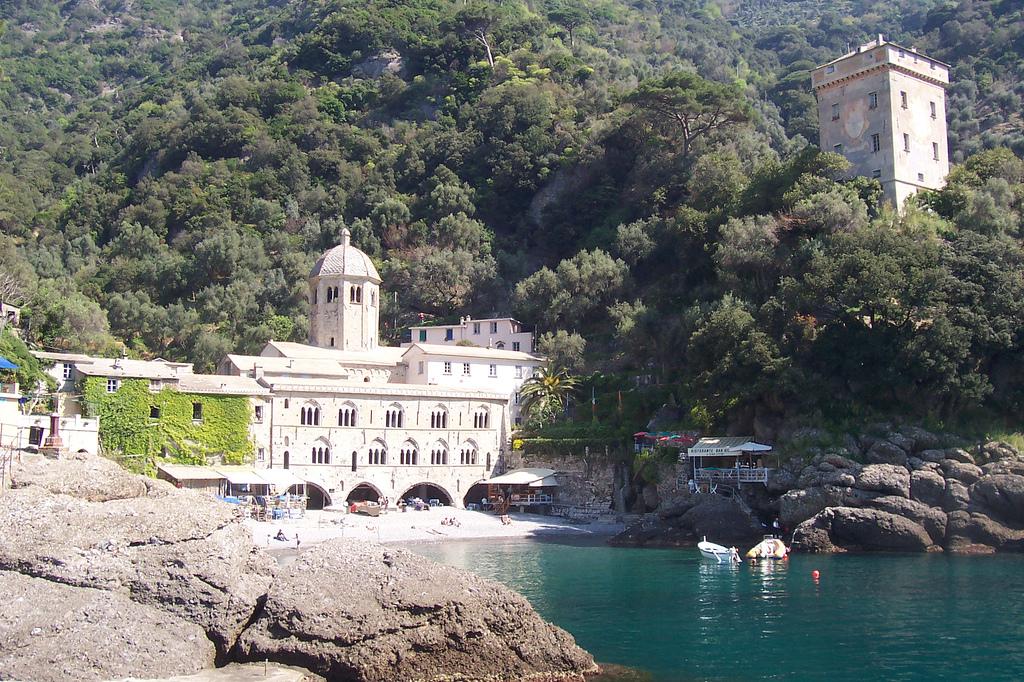
The San Fruttuoso abbey is the best-known religious complex on the Portofino headland: a Romanesque-Gothic abbey set in a closed bay, accessible only on foot or by sea, surrounded by the Mediterranean scrub of the park’s southern slope. Its distinctive feature is precisely this difficulty of access: no roads, no cars, no parking. You arrive by walking one or two hours along the park paths or by stepping off the ferry that leaves from Camogli, Portofino, Santa Margherita Ligure or Rapallo.
History: from the Benedictine monks to the Doria
The origins go back to the 8th century, but the core of the monastery visible today dates to the second half of the 10th century, with the Romanesque cloister developed over the two following centuries and the Doria tower added in 1562 as protection against Saracen raids. The complex was long tied to the Genoese Doria family: the tower, the lower crypt and various parts of the structure carry the family coat of arms and house the tombs of members of the dynasty between the 13th and 15th centuries.
In the 1980s, after decades of decay, the complex was donated by the Doria to the Fondo Ambiente Italiano (FAI), which oversaw its restoration and today manages it as a property open to the public. For the full history see also the entry San Fruttuoso on Wikipedia.
What you visit
The visitor route managed by the FAI includes:
- The upper cloister in Romanesque style, with hanging arches and clustered columns.
- The abbey church with the lower crypt and the Doria tombs in white marble and slate.
- The exhibition rooms on the upper floor, where archaeological finds and a collection of medieval ceramics from excavations are gathered.
- The Doria Tower, from whose top you take in the bay and the southern slope of the headland.
The pebble beach of San Fruttuoso is small and free: in front of the abbey you can swim. There are two long-standing trattorias, a few bars and nothing else: at San Fruttuoso there is no road, no grocery shop, no pharmacy.
The Christ of the Abyss
At around 17 metres depth in the bay of San Fruttuoso, in front of the abbey, lies the statue of the Christ of the Abyss: a bronze 2.5 metres tall by the sculptor Guido Galletti, laid on the seabed on 22 August 1954 as a monument to all those lost at sea. The statue is visible to those who scuba dive (authorised through local diving centres) or who snorkel (when water clarity allows). A twin replica lies in the waters of St George’s Bay in Grenada. The original statue was recovered, restored and re-laid in 2003.
How to get there by sea
The ferries of the Servizio Marittimo del Tigullio and of Golfo Paradiso (for the Camogli crossing) connect San Fruttuoso to:
- Camogli: the shortest and most direct crossing, around 25 minutes of sailing.
- Portofino: around 20 minutes, higher frequency in high season.
- Santa Margherita Ligure: around 40 minutes.
- Rapallo: around 60 minutes, with connection at Santa Margherita.
Crossings are concentrated from Easter to mid-October, with frequency varying by season and weather. In winter the service is reduced significantly. Fares vary by route and one-way or return: check the current schedule and prices on the operators’ websites. The other transport options to the headland are covered on the how to get there page.
How to get there on foot
San Fruttuoso is reachable from the main access points to the Park of Portofino. The most-walked routes:
- From Portofino village (coastal path): around 2 hours of walking, 300 m elevation gain, rocky sections and stone steps. Splendid but demanding.
- From Portofino Vetta via Pietre Strette: around 2 hours, an inland route with views from above.
- From Ruta di Camogli via Pietre Strette: around 2 hours 30 minutes, access from the north-west.
- From Base 0 (Santa Margherita) via Olmi: 3 hours, a longer and less frequented route.
For all the routes: trekking shoes, at least 1.5 litres of water, hat and sun protection. The southern slope offers little shade in summer. For the full path network see the Portofino Natural Park page.
Opening times, tickets and accessibility
The site is managed by the FAI as a property open to the public with an entrance ticket. Opening times are seasonal, with separate calendars for spring-summer, autumn and winter, and extended closures during some weeks of January-February. FAI members have free entry. Always check the current schedule and any exceptional closures on the official FAI page before organising your visit: the abbey is reachable only by sea or on foot, and arriving with the doors closed means waiting for the next ferry.
Accessibility for people with reduced mobility is limited: the landing beach is pebbly and the abbey complex has steep stairs. FAI staff can provide specific information on request.
When to go
May and June for calm seas, regular ferries and few crowds. September for water still mild and fewer tourists than in July-August. In July and August the ferries need to be booked in advance and queues can be long; arriving on foot becomes a real alternative for walkers. In winter the bay is rich in silence but the ferry service is reduced and the abbey may be closed for weeks at a time: in that case the path remains the only way in, but you then need to walk back out.
What to bring with you
For a day visit to San Fruttuoso abbey we recommend: shoes suitable for walking on the smooth pebbles of the bay, swimsuit and towel if you intend to stop and swim, water (the two trattorias of the bay charge tourist prices for mineral water), sun cream, hat, cash for small purchases (card readers are intermittent), FAI card if you have one for free or reduced entry. For those arriving on foot, standard trekking equipment. There are no luggage or safe-deposit services: bring only what is strictly necessary.
Staying in the area
San Fruttuoso offers no accommodation in the bay (the two long-standing trattorias have rooms only on an exceptional basis, reserved for regular guests, not commercially advertised). For those who want to experience the bay at sunset or sunrise, the answer is to stay in Camogli: the first ferries of the morning leave around 9-10 in high season and the bay, before the arrival of day visitors, is unusually quiet. See the where to stay page for accommodation options in the Tigullio.
Combining the visit with other stops
A full-day itinerary can combine: morning on foot from Portofino along the coastal path, lunch and a swim in the bay at San Fruttuoso, return in the early afternoon by ferry to Portofino village, afternoon in the Piazzetta and Castello Brown. It is a realistic plan only from May to September, when the days are long and the ferries run until sunset. In the low season it is better to dedicate a focused half-day to San Fruttuoso, taking the first ferry of the morning from Camogli.
San Fruttuoso abbey is one of those places in the Tigullio where history, landscape and limited accessibility coexist consistently: the difficulty of reaching it is part of the experience, and this is also why it remains less crowded than other FAI sites in Italy.